
Blast-Resistant Louvres
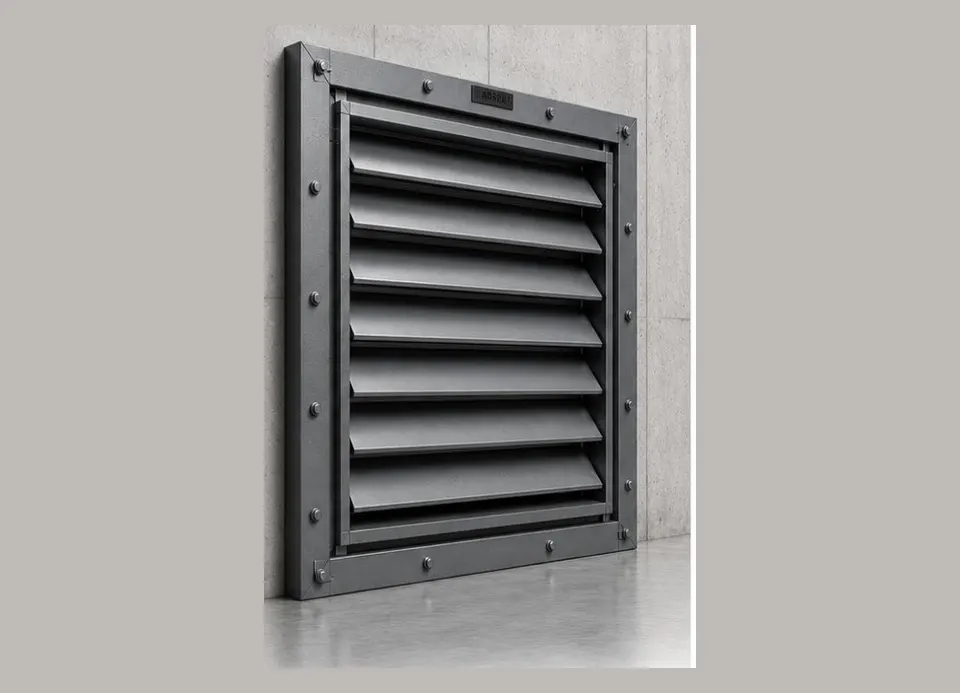
Blast-resistant louvres and vents withstand blast pressure and impact effects while still allowing air relief, ventilation and pressure equalisation. They are built with a blast-resistant blade profile, fixed or adjustable, in carbon or stainless steel.
How it works
A blast-resistant louvre keeps an air opening in a wall, shaft or duct available for ventilation, air intake or pressure relief, but is built so that the blades, frame and fixings take the blast load instead of failing. A blast-resistant blade profile, a strong frame and anchoring to the structure carry the load. Blades can be fixed or adjustable, and options such as a blast valve, motorised damper or fire damper can be added where the opening must close when a blast or fire threatens.
Typical applications
- Ventilation and air-intake openings of blast-resistant buildings
- Pressure relief and pressure equalisation openings
- Critical infrastructure and transport facilities
- Warehouse and logistics centres
Product range data
Values are indicative. Final values are set per project through engineering analysis, test reports and certificates. The standards named are a reference framework, not a certification claim.
- Design blast load: from 0.1 bar up to 45 bar and above, set per project
- Blades: fixed or adjustable, blast-resistant blade profile
- Frame and blades: carbon steel or stainless steel
- Surface protection: epoxy primer with polyurethane topcoat; hot-dip galvanising optional
- Seals: EPDM or silicone (optional)
- Operating temperature: −40 °C to +80 °C
- Fitting: in a wall, shaft or duct
- Options: blast valve, sand and rain trap, insect or bird screen, motorised damper, fire damper
Standards and guidance commonly referenced for this product type
These are general references. Compliance and test reports for a specific product are provided per project.
Does a blast-resistant louvre keep the blast out of the room?
It is designed to withstand the blast load on the opening so that the louvre itself does not fail and break into the room. How much pressure passes through the open area depends on the louvre and the room behind it, so for rooms that must stay protected a blast valve or a closing damper is added and the whole ventilation path is checked.
What is needed to select a blast-resistant louvre?
The blast load at the opening, the opening size, the airflow and allowed pressure loss, the mounting (wall, shaft or duct), the environment (temperature, rain, dust, salt) and any need for a blast valve, damper or fire rating.
Technical specifications, protection levels and test reports are provided per project. Contact our engineers for details.
Planning a protected facility?
Tell us about your site, threat scenario and timeline. Our engineers will respond with the right solution.